
Silk Route Package Tour From Kolkata
DESTINATION
Silk Route
DURATION
4-7 Days
GRADE
Moderate
START/END POINT
REGION
MAX ALTITUDE
GROUP SIZE
2-12
ACTIVITY
Book Silk Route Package Tour From Kolkata
Overview
Long before the name “Silk Route” entered travel brochures, this high-altitude corridor in East Sikkim carried caravans of wool, salt, and silk between Tibet and British India. Merchants, monks, and soldiers wound their way along precipitous ridges, across frozen passes, and through dense cloud-forests where rhododendrons bloom impossibly bright. Today, the same route — threading through Zuluk, Thambi View Point, Nathang Valley, and Kupup — offers travellers one of the most dramatic and least-commercialised landscapes in the Indian Himalaya.
A Silk Route package tour from Kolkata typically covers the old Indo-China trade route in East Sikkim, reaching altitudes above 14,000 feet. Unlike the crowded circuits of Darjeeling or Gangtok, the Silk Route still retains an unhurried, almost otherworldly stillness. You may share a dawn viewpoint with a handful of fellow travellers rather than a thousand; you may find your homestay run by a family who still farms the same terraces their grandparents did. That sense of encountering something genuine — not staged for tourists — is what makes this journey exceptional.
Geographical Specifications
The Silk Route corridor lies in the eastern arm of Sikkim, hugging the border with China (Tibet) as it climbs from the subtropical Teesta Valley to the high trans-Himalayan plateau. The route follows a series of ridgelines that average between 10,000 and 14,500 feet, offering an almost continuous panorama of snow-capped peaks, including Kanchenjunga, the world’s third-highest mountain.
Unlike the wetter, thickly forested western slopes of Sikkim, the eastern Silk Route passes through a rain-shadow zone. This gives the landscape a starker, more Central-Asian character — short alpine grass, wind-sculpted rock, frozen lakes, and yak herders moving their animals between seasonal pastures. The transition is startling: within a two-hour drive from Gangtok, you move from dense rhododendron forests into an open, treeless high plateau that feels like Tibet.
Best Time to Visit the Silk Route from Kolkata
Post-Monsoon & Early Winter |
Crystal-clear skies after the monsoon flush the air clean. Snow begins dusting the high passes from November onward, and Nathang Valley often wears a white blanket by December. Kanchenjunga views are at their sharpest. Temperatures drop steeply — nights at Nathang can fall to -10°C or below in December — so heavy woolens and thermals are essential. This is widely regarded as the finest window for the Silk Route, combining dramatic snowscapes with reliable clear visibility. |
Spring |
The hillsides ignite with rhododendron and primula blooms, especially below 11,000 feet. Snow often lingers at Nathang and Kupup into March, so you may catch both colour and snow. Days are pleasantly warm at lower altitudes but cold at the high points. April and May are excellent months — roads are clear, flowers are peak, and tourist crowds are still relatively modest compared to popular Darjeeling-area circuits. |
Monsoon |
The Silk Route receives less rain than western Sikkim due to its rain-shadow position, but landslides and road closures remain a real risk on mountain roads during heavy monsoon spells. Some sections may be impassable. For adventurous travellers who can be flexible with plans, the monsoon reveals lush green valleys and swollen waterfalls. However, this season is best avoided unless you are comfortable with itinerary uncertainties and possible permit delays. |
Silk Route Package Tour Highlights
The Silk Route offers a quality of experience that is increasingly rare in Indian Himalayan tourism — a landscape that feels unmediated, a history that is tangible, and a pace that allows genuine encounter rather than hurried tick-boxing. Here are the moments that define this journey.
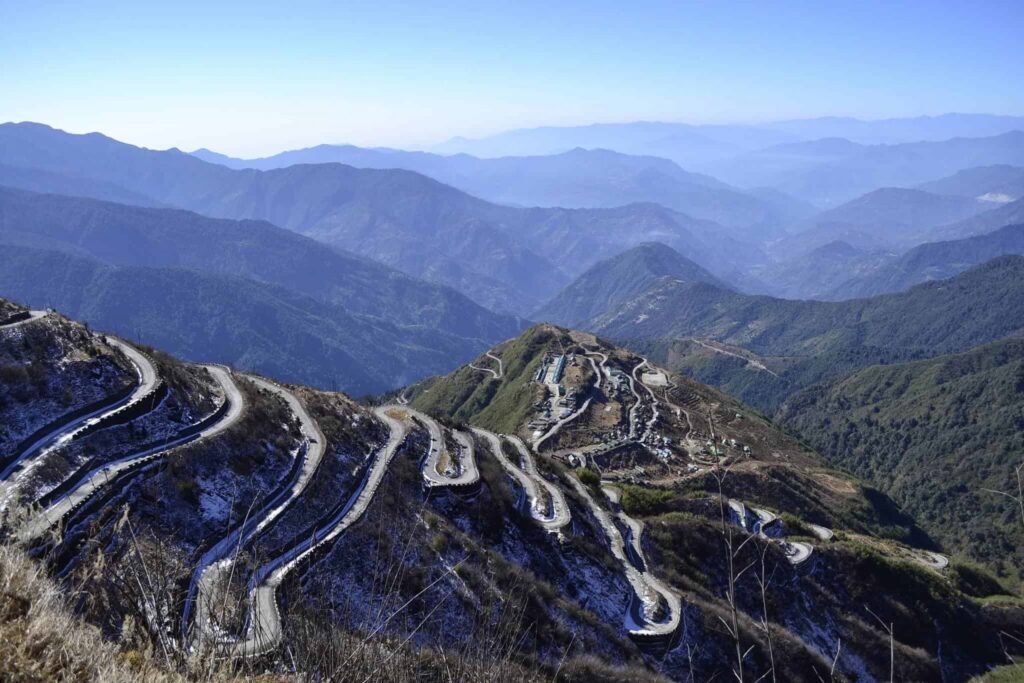
- The 32 Hairpin Bends of Zuluk
- Thambi View Point at Sunrise
- Nathang Valley — The Roof of Sikkim
- Kupup Lake (Elephant Lake)
- Old Baba Mandir — A Sacred High-Altitude Shrine
- Homestays in Village Zuluk
- Aritar Lake and Monastery
- An Ancient Trade Route with Tangible History
Photo Gallery
Places You'll See
Video Gallery
Silk Route Package Tour Itinerary From Kolkata
Your tour vehicle meets you at NJP station in the early morning. The drive climbs quickly from the Teesta Valley plains, winding through tea gardens and dense subtropical forest. Arrive at Aritar by midday and check in to your guesthouse.
The afternoon is ideal for a leisurely walk around Lampokhari Lake — Sikkim’s largest natural lake — surrounded by prayer flags, willows, and the gentle sound of a small waterfall. Visit the adjacent Aritar Monastery (Rhenock Monastery), a 200-year-old gompa perched on a forested ridge above the lake, for a grounding introduction to Sikkimese Buddhist culture before you ascend to higher altitudes. Dinner and overnight at homestay/guesthouse in Aritar.
After an early breakfast, begin the scenic drive towards Rongli, where permit checkpoints verify your Inner Line Permit. The road then follows the Rongli Chu river upstream before beginning the famous 32-hairpin-bend ascent to Zuluk — a sequence of looping switchbacks so dramatic that travellers often stop multiple times to photograph the road doubling back on itself across the valley below.
Arrive in Zuluk (approx. 9,600 ft) by early afternoon. Settle into your homestay — these family-run places are genuinely warm, serving homemade dal-bhat, local pickles, and strong ginger tea. Late afternoon, take a gentle acclimatisation walk through the small village, which has striking views west across forested ridges. If clear, the peaks of Kanchenjunga begin to appear above the ridge to the north-west. Overnight at Zuluk homestay.
The centrepiece day of the tour begins before dawn. Wrap up warmly and drive up the switchbacks to Thambi View Point (approx. 12,400 ft) in time for sunrise. When conditions are clear, this is one of the most spectacular mountain panoramas in India — Kanchenjunga, Simvo, Siniolchu, and Chomolhari spread across the horizon in full alpenglow. Allow at least 30–45 minutes here; no photograph does it justice.
Continue upward to Nathang Valley (approx. 13,500 ft), a sweeping high plateau that feels transported from the Tibetan plateau. Check in to your accommodation — basic but well-heated government tourist lodges or private guest houses — and take time to acclimatise before lunch. The altitude is significant; move slowly, stay hydrated, and avoid exertion immediately on arrival.
After lunch, drive to Kupup Lake (Elephant Lake, approx. 13,800 ft) — an extraordinary high-altitude wetland, frozen solid in winter and a migratory bird stopover in spring. Continue to Old Baba Mandir near 14,000 ft, the original shrine of Baba Harbhajan Singh, a place of deep spiritual significance for the Indian Army and a genuinely moving site. Return to Nathang by late afternoon. Spend the evening around a warm bukhari (wood-burning stove) with dinner. On clear nights, the starfield at Nathang is extraordinary. Overnight in Nathang.
After one final morning walk in Nathang — often the most vividly remembered hour of the entire trip, as the light on the snow peaks turns from rose to gold — begin the descent. Many tour operators include an optional stop at Tsomgo (Changu) Lake (approx. 12,400 ft) en route to Gangtok, a beautiful glacial lake with a small lakeside temple and vendors selling traditional Sikkimese snacks.
Pass through Gangtok for lunch — Sikkimese momos, thukpa, and local snacks at one of the town’s well-regarded restaurants. If time permits, a brief stop at the Rumtek Monastery or a walk along MG Marg (the pedestrianised town centre) provides a pleasant coda before the drive down to the plains.
Arrive at NJP or Siliguri by evening to connect with your overnight train back to Kolkata. With a late-evening departure, you return to Kolkata the following morning — having covered one of the great Himalayan journeys in just four days.
Places to Visit on the Silk Route Package Tour From Kolkata 2026
Each stop on the Silk Route has its own distinct character. Together they form a journey that moves through human history, natural beauty, and spiritual landscape in a way few Himalayan circuits can match.
Zuluk (Dzuluk)
A small ridge-top village perched at around 9,600 feet, Zuluk is the gateway to the high Silk Route. Its modest cluster of homestays and prayer-flag-lined lanes feel genuinely off-the-beaten-track. The famous 32-hairpin approach road is reason enough to visit, but the village itself — with its views, birdlife, and warm local hospitality — earns an overnight stay rather than merely a drive-through.
Thambi View Point
At roughly 12,400 feet, Thambi View Point is the finest sunrise-watching perch on the Silk Route. On clear mornings — most common in October–December and March–April — the unobstructed 180-degree panorama encompasses Kanchenjunga (8,586 m), Chomolhari, Kabru, and the full sweep of the eastern Himalayan frontier. The view is best before 8 AM, before valley mist begins to build.
Nathang Valley (Gnathang)
The emotional and scenic heart of any Silk Route tour. At 13,500 feet, Nathang is a vast, open plateau of alpine meadow and moraine where the sky seems impossibly large. In winter it fills with snow; in spring, wild flowers push through the frost-cracked ground with startling colour. An old British military rest camp still stands here. The nights — cold, clear, and blazing with stars — are transformative.
Kupup Lake (Elephant Lake)
Named for its elephant-ear shape when viewed from the surrounding ridges, Kupup Lake sits at around 13,800 feet and freezes over from December to February to form a pristine white expanse. It is also designated as an important bird area on the Central Asian Flyway, attracting bar-headed geese, brahminy ducks, and other migratory species in spring and autumn. The landscape surrounding the lake is among the most austere and beautiful in East Sikkim.
Old Baba Mandir
Nestled near 14,000 feet on a windswept ridge, the original shrine of Sepoy (Baba) Harbhajan Singh is one of the most spiritually charged sites on the route. The Indian Army reveres Baba as a guardian of the border, and soldiers stationed here keep the shrine meticulously. The story of Baba Harbhajan Singh — and the manner in which local people, both military and civilian, speak of him — offers a window into the deeply human dimension of this geopolitically sensitive frontier.
Aritar (Lampokhari Lake)
Often the first overnight stop on a Silk Route tour, Aritar is a gentle, forested village centred on the largest natural lake in Sikkim. The lake reflects surrounding fir trees and rhododendrons, and a small waterfall feeds it at one end. The adjacent Rhenock Monastery — also called Aritar Gompa — dates back over two centuries. It serves as an excellent lower-altitude introduction to Sikkimese landscapes and culture before the dramatic high-altitude ascent to come.
Tsomgo (Changu) Lake
Located at 12,400 feet on the Gangtok–Nathu La highway, Tsomgo is a glacial lake framed by steep mountain walls and visited year-round by travellers. It freezes over in winter to a shade of deep jade-green, while in spring, rhododendron blooms cascade down the surrounding slopes. Tsomgo is typically included as an en-route stop on the return day from Nathang to NJP and adds little time to the journey while delivering spectacular scenery.
Rongli & Rorathang
The route ascent passes through these small Teesta Valley towns, which serve as the permit checkpoint for the restricted Silk Route area. Rongli sits at the confluence of the Rongli Chu and Teesta rivers, a lively roadside bazaar with local tea stalls and small eateries. Rorathang, slightly higher, marks the beginning of the dramatic switchback climb. Both are pleasant rest stops and offer a glimpse of ordinary East Sikkimese daily life before the landscape turns high and austere.
Frequently Asked Questions
Indian nationals require an Inner Line Permit (ILP) to enter the restricted areas of the Silk Route, including Zuluk, Nathang, Kupup, and Old Baba Mandir. This can be obtained from the Sikkim Tourism Office in Gangtok or Siliguri, or through your tour operator before departure — which is the easiest option. Foreign nationals require a Restricted Area Permit (RAP) in addition to the ILP; this must be obtained through a registered tour operator in India and requires a minimum group of two people.
When you book a Silk Route package tour from Kolkata with a reputable operator like Bengal Tour Plans, permit processing is handled on your behalf. Carry photocopies of your Aadhaar / passport and the original permit at all times — checkpoints at Rongli, Nathang, and Kupup verify documents.
Yes, altitude sickness is a genuine consideration. Nathang Valley sits at approximately 13,500 feet and Old Baba Mandir at 14,000 feet — elevations where reduced oxygen can cause headache, nausea, dizziness, and breathlessness in those not acclimatised. The standard 4-day itinerary is designed with a gradual ascent (Aritar at 4,000 ft → Zuluk at 9,600 ft → Nathang at 13,500 ft) which helps considerably.
To further reduce risk: stay well hydrated, avoid alcohol on the first night at altitude, eat light meals, ascend slowly on foot during acclimatisation walks, and avoid strenuous activity immediately on arriving at a new altitude. Carry a course of Acetazolamide (Diamox) only after consulting your physician. Travellers with pre-existing cardiac or pulmonary conditions should seek medical advice before booking. Symptoms that persist or worsen — particularly difficulty breathing at rest — require immediate descent.
The standard and most practical approach from Kolkata is to take an overnight train to New Jalpaiguri (NJP) or Siliguri Junction — multiple daily services run from Howrah and Sealdah, with journey times of approximately 10–12 hours. Your tour vehicle picks you up at NJP in the early morning and drives to the first night’s destination, typically Aritar or directly to Zuluk (for shorter itineraries).
Alternatively, you can fly to Bagdogra Airport (IXB) from Kolkata (40–50 minutes), which reduces travel time significantly and is advisable for those with limited leave. From Bagdogra, it is approximately 130 km (4–5 hours) to Zuluk. Booking a full package tour that includes all transfers from Kolkata is the simplest option and removes the logistical burden of arranging permits, vehicles, and homestays independently.
Packing for the Silk Route requires preparing for a significant temperature range — from 18–22°C at lower altitudes like Aritar to well below 0°C at Nathang on winter nights. Essential items include: thermal base layers (top and bottom), mid-layer fleece, a windproof and waterproof outer jacket, warm gloves and a beanie hat, woolen socks, and sturdy waterproof walking shoes or ankle-height trekking boots. A balaclava or neck gaiter is strongly recommended for Thambi View Point visits at dawn.
Other important items: sunscreen (SPF 50+; UV radiation is intense at altitude), UV-protection sunglasses, a small personal first-aid kit with altitude medication if prescribed, a power bank (electricity at Nathang can be intermittent), and sufficient cash in smaller denominations (ATMs are unavailable on the route itself — carry cash from Gangtok or Siliguri). A good quality headlamp with extra batteries is useful for early morning viewpoint drives.
The Silk Route is generally suitable for families with older children (12 years and above is a common guideline) and for reasonably fit elderly travellers, with some important caveats. The tour involves no trekking — it is entirely vehicle-based — and most viewpoints require only short walks of 5–15 minutes. This makes it accessible compared to many Himalayan destinations.
However, the altitude at Nathang (13,500 ft) and Kupup (13,800 ft) is significant. Children under 10, pregnant travellers, and those with heart, lung, or blood-pressure conditions should consult a physician before booking the high-altitude sections. For families with young children, a modified itinerary that stays below 11,000 feet (Zuluk, Thambi, Aritar) is enjoyable and far less demanding. Bengal Tour Plans can customise the itinerary based on your group’s profile and comfort level — simply mention this when enquiring.
Bengal Tour Plans curates small-group and private Silk Route packages from Kolkata — all permits, transfers, homestays, and meals handled end-to-end.
Customer Reviews
EXCELLENTTrustindex verifies that the original source of the review is Google. Had a great experience with the tour organizer. Everything was well planned and smoothly managed. Highly recommended!Posted onTrustindex verifies that the original source of the review is Google. Me & my family fully enjoyed 7 night 8 days package trip to Kolkata and Mandarmani. I recommend "Bengal Tour Plans" as perfect holiday planner who provides great deal for customized holiday and well behaved and knowledgeable staffs always gives the sense of safety and quality trip. Special thanks to Mrs Mithu Mukherjee and Mr Shantanu for their wonderful plan which made our holiday a sweet and everlasting memory. Looking forward for another trip with "Bengal Tour plans" in coming years.Posted onTrustindex verifies that the original source of the review is Google. We visited Satkosia with Bengal Tour Plans during the last 2days of 2025 and on 1 Jan 2026 and it was an wonderful experience. They provided us luxurious stay along with lovely food. Above all the behaviour of their every staff during our stay was just unimaginable!! We will love to refer them to our near and dear ones.... Keep growingPosted onTrustindex verifies that the original source of the review is Google. The resort is in the lap of nature,well maintained still one can feel the tranquility of nature.The river is slightly away from the resort but the road is itself an experience,The most important part is the behaviour of the stuff,They are very co operative, will always attend u with a big innocent smile.The barbecue is highly recommend.We really enjoyed the campfire.Posted onTrustindex verifies that the original source of the review is Google. We visited Arunachal Pradesh in the last week of December 2025 and Bengal Tour Plans made it a truly memorable experience. They arranged a comfortable vehicle and excellent stay options, with complete transparency in communication—there were no misunderstandings at any point. Shantanu-da planned the entire trip with great care—more like a family member than a tour operator—and personally checked in with us every day to ensure everything was going smoothly. I would definitely recommend Bengal Tour Plans to anyone looking for a well-organized and personalized travel experience.Posted onTrustindex verifies that the original source of the review is Google. Thank you bengal tours planPosted onTrustindex verifies that the original source of the review is Google. Coastal Park Guest house and Bengal tour plan offers an exceptionally pleasant and comfortable stay, combining excellent hospitality with a prime seaside location. The guest house is perfectly positioned, providing a breathtaking wide view of the sea and beach that enhances the overall experience and creates a calm, relaxing atmosphere. Guests can enjoy uninterrupted ocean views, making it an ideal choice for both leisure and peaceful retreats. A special mention must be given to the caretaker, Hasan Da, whose professionalism, gentle manner, and warm behaviour truly set this guest house apart. He is extremely well-behaved, courteous, and always ready to assist guests with a smile, ensuring a welcoming and homely environment throughout the stay. The quality of food served at Coastal Park Guest House is outstanding. Meals are freshly prepared, hygienic, and rich in taste, reflecting excellent culinary standards. Overall, Coastal Park Guest House delivers comfort, scenic beauty, and exceptional service, making it a highly recommended destination for a memorable coastal stay.Posted onTrustindex verifies that the original source of the review is Google. Thank you Bengal Tour Plans
MAP
Other Similar Activities
No related packages found.